

GSI EXAMPLES


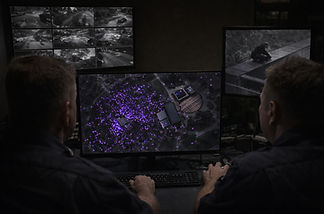
Large gatherings such as campus events, public speeches, or political rallies create complex security environments where crowd safety and situational awareness are critical. In this example, a large concentration of devices represents a crowd gathered around an outdoor stage, while a smaller cluster appears in the backstage area where event personnel are operating. Away from the crowd, a single device appears in an elevated location that maintains a clear line of sight to the stage and the assembled audience. Spatial intelligence allows security teams to recognize unusual device placement and investigate whether activity in that location is expected or potentially concerning. This capability provides event security teams with an additional layer of awareness when monitoring large gatherings and high-profile speakers.


This visualization illustrates how GHOST Spatial Intelligence™ can reveal sudden changes in movement patterns across a corporate environment. In this scenario, hundreds of mobile devices begin moving rapidly from a building toward nearby parking areas. Such a pattern may indicate a fire alarm, hazardous condition, violent incident, or other emergency requiring immediate evacuation. Rather than waiting for reports from inside the building, security personnel can observe the developing situation through spatial intelligence and recognize that a mass movement event is occurring. This early visibility allows security teams and emergency responders to assess the situation more quickly, deploy personnel to the appropriate location, and coordinate response efforts with greater situational awareness.


University campuses often contain restricted or controlled-access areas that should not experience routine activity outside of authorized personnel. In this example, spatial intelligence identifies device activity appearing inside a gated zone that normally remains quiet. By monitoring patterns of device presence over time, GHOST Spatial Intelligence™ can recognize when activity occurs in areas where it should not. Security personnel can receive alerts when movement appears inside these defined boundaries, allowing campus police or security teams to investigate potential unauthorized access, suspicious behavior, or safety concerns before the situation escalates.

This visualization demonstrates how GHOST Spatial Intelligence™ can reveal movement patterns across a port environment in real time. A cruise ship is docked at the terminal with a small number of devices still visible aboard the vessel while a much larger concentration of devices is moving from the ship onto the dock and outward through the port facility toward parking and transportation areas.
In some situations this pattern may represent normal operational activity following the arrival of a cruise ship as passengers disembark and move through the terminal toward ground transportation, parking areas, or nearby facilities. By studying these patterns over time, port authorities and security professionals can better understand the normal rhythm of passenger flow, staffing needs, and infrastructure utilization.
In other circumstances the same pattern could signal an emergency developing on the vessel or within the terminal environment. A sudden surge of devices rapidly leaving the ship may indicate a fire, mechanical failure, hazardous condition, or other maritime incident requiring immediate evacuation. By observing these patterns in real time, security teams and emergency managers can quickly recognize abnormal activity and begin coordinating response resources even before the full details of the situation are known.
This dual capability allows GHOST Spatial Intelligence™ to serve both operational analysis and emergency situational awareness, giving maritime operators and port security teams a powerful tool for understanding normal conditions while also detecting early indicators of large scale incidents.